

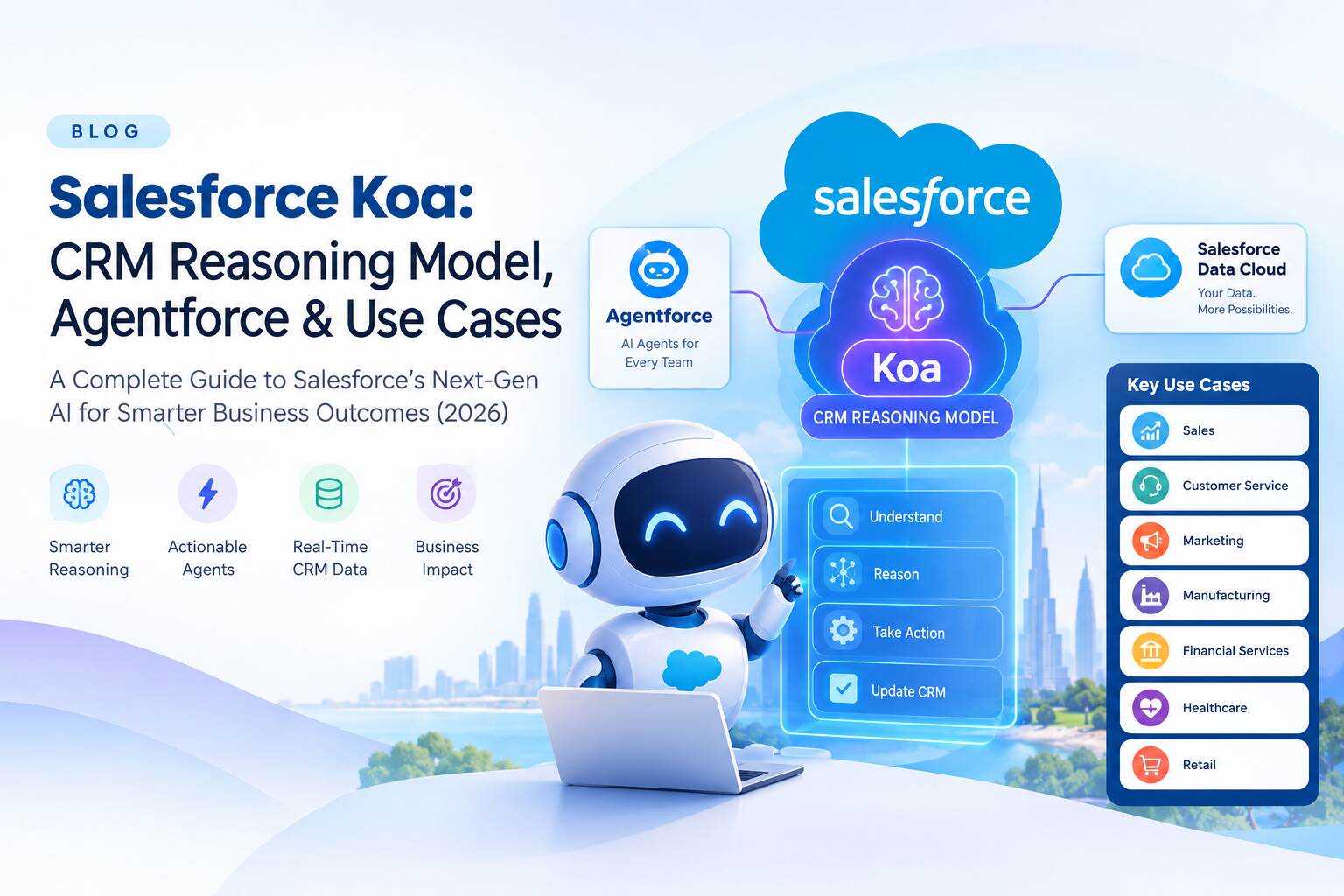
Salesforce Koa: CRM Reasoning Model, Agentforce & Use Cases (2026)
Published by Swasti Datamatrix | Salesforce Development & Consulting
Artificial intelligence is moving beyond chatbots and simple question-answering. Enterprise AI agents increasingly need to understand business context, reason through multiple steps, select the right tools, and execute actions inside business systems.
Salesforce has introduced Koa, its first CRM reasoning model designed specifically for Agentforce. Built in collaboration with NVIDIA and based on NVIDIA Nemotron, Koa is designed to help Agentforce agents handle complex, multi-step CRM workflows across sales, service and other enterprise processes. Salesforce announced Koa on September 15, 2026.
For organizations already using Salesforce or planning a Salesforce AI strategy - Koa introduces another important layer to consider alongside Agentforce, Salesforce Data Cloud, CRM data, automation and custom Salesforce development.
This guide explains what Salesforce Koa is, how it works with Agentforce, its potential business use cases, implementation considerations and how a Salesforce development company such as Swasti Datamatrix can help organizations prepare for and implement Koa-powered solutions.
What Is Salesforce Koa?
Salesforce Koa is Salesforce's first CRM reasoning model for Agentforce, built on NVIDIA Nemotron.
Unlike a general-purpose AI model designed to handle a very broad range of tasks, Koa has been developed specifically around CRM-related reasoning and enterprise workflows.
According to Salesforce, Koa was post-trained using a proprietary synthetic dataset modeled on nearly three decades of CRM deployments. The scenarios cover reasoning, tool use and decision-making across workflows such as lead generation, opportunity qualification and service-case resolution, spanning more than 14 industries.
The important concept is:
Koa is a reasoning model designed for CRM work; Agentforce provides the agentic layer that can use models, context, instructions and actions to perform business tasks.
Koa therefore should not be viewed simply as another Salesforce feature or another chatbot.
It is part of the AI model layer that can help power Agentforce experiences.
Salesforce Koa at a Glance
| Feature | Salesforce Koa |
|---|---|
| What is it? | CRM reasoning model |
| Designed for | Agentforce |
| Technology foundation | NVIDIA Nemotron |
| CRM focus | Sales, service and enterprise workflows |
| Training approach | Post-training using proprietary synthetic scenarios |
| Customer data used for training | No, according to Salesforce |
| Enterprise focus | Multi-step CRM reasoning and tool use |
| Availability | Select pilot customers |
| Expected U.S. GA | Winter 2026 |
| Deployment | Salesforce-managed model options |
Salesforce says Koa can be selected as a managed LLM in the Data Cloud generative models catalogue, enabled as an Agentforce model provider, or selected at the agent/sub-agent level.
Why Is Salesforce Koa Important?
Traditional CRM automation generally follows predefined logic.
For example:
New Lead
   ?
Check Lead Source
   ?
IF Industry = Manufacturing
   ?
Assign Sales Team
   ?
Create Task
This is useful when the process is predictable.
But enterprise processes can become much more complicated.
A sales representative might ask an AI agent:
"Review this opportunity, look at the customer's previous interactions, identify the outstanding issues, determine the next appropriate action and update the CRM."
That requires more than generating text.
The system may need to:
-
Understand the request
-
Retrieve relevant CRM context
-
Evaluate multiple records
-
Determine which actions are appropriate
-
Use Salesforce tools
-
Follow business rules
-
Update records
-
Maintain context
-
Provide a response
This is the type of multi-step reasoning that Salesforce designed Koa to support.
How Does Salesforce Koa Work With Agentforce?
A simplified architecture can look like this:
                    User / Customer
                           |
                           v
                    Agentforce Agent
                           |
                           v
                    Agent Reasoning
                           |
                           v
                    Salesforce Koa
                           |
              +------------+------------+
              |            |            |
              v            v            v
         CRM Context     Tools       Business Rules
              |            |            |
              +------------+------------+
                           |
                           v
                   Salesforce Platform
                           |
             +-------------+-------------+
             |             |             |
             v             v             v
         Sales Cloud   Service Cloud   Data Cloud
Koa does not replace Salesforce CRM, Agentforce, Data Cloud, Apex, Flow or integrations.
Instead, it can become part of the intelligence layer supporting Agentforce.
Salesforce says Koa can be used at the organization level, for individual agents and sub-agents, and through the Data Cloud generative models catalogue.
Salesforce Koa vs Traditional Generative AI
One of the biggest differences is specialization.
General-purpose models can be extremely capable across many domains. However, enterprise CRM workflows require knowledge of business processes, records, tools, permissions, actions and operational context.
Salesforce's approach with Koa is to specialize the reasoning model around CRM work.
For example:
General AI request
"Write an email to a customer about their order."
CRM agent request
"Review the customer's account, recent opportunities, open cases and previous interactions. Determine the appropriate follow-up and update the opportunity."
The second workflow requires access to business context and potentially multiple actions.
That is where CRM-specific reasoning becomes relevant.
Salesforce reports that on its CRM Bench, Koa matches or exceeds leading-model performance on certain CRM actions while producing fewer errors. Salesforce also reports improvements in action precision, context reliability and long-conversation context retention. These are Salesforce's own benchmark results and should be evaluated against the specific requirements of each organization's implementation.
What Can Salesforce Koa Be Used For?
Salesforce says Koa's synthetic training scenarios cover CRM workflows across more than 14 industries.
Potential enterprise applications include:
1. AI Sales Agents
Koa-powered Agentforce solutions can potentially assist sales teams with workflows such as:
-
Lead qualification
-
Opportunity analysis
-
Account research
-
Follow-up preparation
-
CRM updates
-
Sales activity summaries
-
Next-step recommendations
-
Multi-step sales workflows
For example:
Lead
 ?
Analyze customer information
 ?
Review CRM history
 ?
Evaluate qualification criteria
 ?
Recommend next action
 ?
Update Salesforce
 ?
Create follow-up task
The exact actions available depend on the organization's Salesforce configuration, permissions, agent design and connected systems.
2. AI Customer Service Agents
Customer service is another natural area for CRM reasoning.
A customer might report:
"I have been waiting for my replacement product for several days."
An Agentforce solution could potentially:
Customer Request
       ?
Identify Customer
       ?
Find Account
       ?
Review Case History
       ?
Check Order Information
       ?
Check Previous Interactions
       ?
Determine Appropriate Action
       ?
Update / Route Case
       ?
Respond to Customer
This illustrates why multi-step reasoning is important for enterprise service automation.
3. Opportunity Management
Sales teams frequently maintain large numbers of opportunities.
An AI agent could be designed to help review:
-
Opportunity stage
-
Account history
-
Recent activities
-
Open cases
-
Customer interactions
-
Tasks
-
Previous communications
It could then help sales representatives determine what needs attention.
The agent still needs properly configured permissions, grounding data, instructions and actions.
4. Lead Qualification
Lead qualification is another potential Koa + Agentforce use case.
A solution could evaluate available information and apply an organization's qualification framework.
For example:
Lead Created
     ?
Company Information
     ?
Industry
     ?
Engagement
     ?
Existing CRM Information
     ?
Qualification Rules
     ?
Agent Reasoning
     ?
Recommended Action
The objective is not simply to generate a score.
The larger opportunity is to connect reasoning with appropriate CRM actions.
5. Case Routing and Service Operations
Customer service organizations often have complicated routing requirements.
An AI agent can potentially help determine:
-
Which team should handle a case
-
Whether an existing case already covers the issue
-
What customer information is relevant
-
What action should happen next
-
Whether escalation is appropriate
Salesforce specifically cites case routing as one of the CRM tasks used in its Koa benchmarking.
6. Manufacturing and Industrial Businesses
Manufacturing organizations can have complex customer-service and sales workflows involving:
-
Equipment
-
Service contracts
-
Customers
-
Distributors
-
Spare parts
-
Service cases
-
Field service
-
Warranty information
A Salesforce implementation can connect these workflows with appropriate CRM records and external systems.
For example:
Customer reports equipment issue
             ?
Service Agent
             ?
Customer + Asset + Case
             ?
Review service history
             ?
Check entitlement / warranty
             ?
Determine next action
             ?
Create / update case
             ?
Route to service team
Koa can potentially support the reasoning component of such multi-step agent workflows.
7. Healthcare
Healthcare organizations have complex workflows and strict requirements around data access and governance.
Potential applications can include:
-
Service coordination
-
Case management
-
Administrative workflows
-
Customer/patient communication
-
Internal employee assistance
Any healthcare deployment must be designed around the organization's applicable privacy, security and regulatory requirements.
Salesforce identifies healthcare among the industries represented in Koa's synthetic training scenarios.
8. Financial Services
Financial organizations can use Salesforce for customer management, service and relationship workflows.
Potential AI-agent applications include:
-
Customer service
-
Case management
-
Relationship management
-
Follow-up workflows
-
Internal assistance
-
Information retrieval
Again, the actual implementation must follow the organization's permissions, governance and regulatory requirements.
Salesforce Koa and Data Cloud
Koa does not automatically have unlimited access to an organization's information.
Salesforce states that Koa uses the grounding data, records and instructions that the customer makes available to it.
This makes the surrounding Salesforce architecture extremely important.
A typical architecture could involve:
Salesforce CRM
      |
      +---- Sales Cloud
      |
      +---- Service Cloud
      |
      +---- Marketing Cloud
      |
      +---- Commerce Cloud
      |
      v
   Data Cloud
      |
      v
   Agentforce
      |
      v
     Koa
      |
      v
 Business Actions
Therefore, organizations considering Koa should not look only at the model.
They should evaluate the complete CRM + Data + Agent + Automation + Integration architecture.
Does Salesforce Koa Use Customer Data to Train the Model?
According to Salesforce, customer data is not used to train Koa.
Salesforce says Koa's training corpus was built from synthetic scenarios representing CRM reasoning, tool use and decision-making rather than customer data. Salesforce also states that Koa operates inside its trust boundary.
This distinction is important for enterprise AI discussions.
However, organizations should still evaluate:
-
Data access
-
Permissions
-
Grounding configuration
-
Agent actions
-
Security controls
-
Compliance requirements
-
Data governance
-
Auditability
AI model security should be considered as part of the overall Salesforce architecture rather than as a single-model decision.
Salesforce Koa and Agentforce: What's the Difference?
This is one of the most common questions.
Salesforce Koa
Koa is the CRM reasoning model.
Agentforce
Agentforce is the agentic platform and experience used to build and operate AI agents.
A simplified relationship is:
Salesforce Platform
       |
       +----------------------+
       |                      |
       v                      v
   Agentforce             Data Cloud
       |
       v
    AI Agent
       |
       v
      Koa
       |
       v
CRM reasoning + actions
So Koa and Agentforce should not be treated as competing Salesforce products.
They operate at different layers of the AI architecture.
Salesforce Koa Implementation: What Does a Business Need?
Implementing a Koa-powered Agentforce solution is more than selecting an AI model.
A successful implementation may require several layers.
1. Business Use-Case Discovery
First identify:
-
Which workflow should be automated?
-
Which tasks consume employee time?
-
Which decisions require reasoning?
-
Which actions can safely be automated?
-
Where should human approval remain?
2. Salesforce Data Assessment
Review:
-
Objects
-
Fields
-
Relationships
-
Data quality
-
Duplicate records
-
Historical information
-
Knowledge content
-
Data Cloud
-
External data sources
Poor data quality can limit the usefulness of any CRM AI implementation.
3. Agent Design
Define:
-
Agent purpose
-
Instructions
-
Sub-agents
-
Actions
-
Context
-
Permissions
-
Escalation rules
-
Human handoffs
-
Business rules
Salesforce's newer Agentforce Builder also introduces Agent Script, which combines LLM reasoning with deterministic logic for more controlled agent behavior.
4. Integration
Many enterprise workflows extend beyond Salesforce.
An implementation may need integrations with:
-
ERP
-
SAP
-
Microsoft systems
-
Websites
-
E-commerce platforms
-
Data warehouses
-
Customer portals
-
Internal applications
-
Third-party APIs
This is where Salesforce development expertise becomes particularly important.
How Can a Salesforce Development Company Provide Koa Services?
Koa creates an opportunity for Salesforce development companies to expand beyond traditional customization and integration.
A company can build services around the complete Koa + Agentforce ecosystem.
Salesforce Koa Consulting
A consulting engagement can include:
-
AI readiness assessment
-
Agentforce readiness
-
Koa use-case discovery
-
CRM data assessment
-
AI architecture
-
Security review
-
Governance planning
-
Implementation roadmap
Koa + Agentforce Implementation
A development team can help customers design and deploy:
-
Sales agents
-
Service agents
-
Employee agents
-
Industry-specific agents
-
Custom agent workflows
-
Agent actions
-
Salesforce automation
-
External integrations
Salesforce AI Agent Development
This can include:
-
Agentforce configuration
-
Agent actions
-
Apex development
-
Salesforce Flow
-
APIs
-
Lightning Web Components
-
Data Cloud
-
External system integrations
-
Testing
-
Monitoring
-
Optimization
Koa Agent Optimization
For organizations already using Agentforce, a consulting company can assess:
-
Agent performance
-
Instructions
-
Actions
-
Context
-
Data grounding
-
Tool usage
-
Business rules
-
Human handoffs
-
Error scenarios
The objective is to improve the complete agent architecture rather than simply changing the underlying model.
How Swasti Datamatrix Can Help With Salesforce Koa
Swasti Datamatrix provides Salesforce development services covering customization, implementation, integrations, data migration and ongoing support. Our existing Salesforce practice includes Sales Cloud, Service Cloud, Analytics Cloud, Commerce Cloud and Marketing Cloud services.
As Salesforce moves further into agentic AI, organizations may need development expertise that connects AI capabilities with their existing CRM architecture.
Swasti Datamatrix can support organizations with areas such as:
Salesforce AI & Agentforce Consulting
Assess existing Salesforce environments and identify practical AI-agent opportunities.
Koa Readiness Assessment
Evaluate CRM data, workflows, integrations and business processes before adopting Koa-powered Agentforce solutions.
Agentforce Development
Design and configure AI agents around specific sales, service and operational workflows.
Salesforce Custom Development
Develop Apex, Flow, Lightning components, custom applications and integrations required by the agent architecture.
Salesforce Data & Integration
Connect CRM information with relevant enterprise systems and data sources.
AI Agent Optimization
Review existing agents and identify opportunities for better context, workflow execution, governance and operational control.
For organizations looking for broader Salesforce development capabilities, Swasti Datamatrix's Salesforce Development service covers custom applications, integrations, implementation, migration and ongoing support.
Explore: Salesforce Development Services by Swasti Datamatrix
https://www.swastidatamatrix.com/salesforce-development
Salesforce Koa for UAE and Global Businesses
The introduction of Koa is particularly relevant for organizations looking at Salesforce as an AI-enabled CRM platform rather than simply a system for storing customer information.
Businesses in sectors such as:
-
Real estate
-
Banking and financial services
-
Healthcare
-
Manufacturing
-
Retail
-
Logistics
-
Professional services
-
Technology
-
Travel
can evaluate agentic workflows according to their own business requirements.
For organizations in the UAE, Saudi Arabia and other international markets, the implementation conversation should include CRM architecture, data governance, integrations, security and localization requirements not just the AI model.
Swasti Datamatrix already provides Salesforce consulting, implementation and Marketing Cloud services for UAE-focused requirements as part of its Salesforce services portfolio.
Is Salesforce Koa Available Now?
Salesforce currently states that Koa is available to select pilot customers.
Salesforce expects general availability in U.S. regions in Winter 2026, with an open beta planned afterward. Availability can change by region, product configuration and release stage, so businesses should verify current Salesforce availability before planning a production deployment.
This means organizations should currently think in terms of:
Assess ? Prepare ? Pilot ? Validate ? Scale
rather than assuming every Salesforce organization can immediately deploy Koa in production.
Salesforce Koa FAQ
What is Salesforce Koa?
Salesforce Koa is Salesforce's first CRM reasoning model for Agentforce, built on NVIDIA Nemotron and designed for complex, multi-step CRM workflows.
Is Koa part of Agentforce?
Koa is a model option designed to power Agentforce agents. It can be selected at different levels within the Agentforce environment according to Salesforce's supported configuration options.
Is Salesforce Koa an AI agent?
No. Koa is a reasoning model. Agentforce provides the agentic platform through which agents can use models, context, instructions and actions.
Does Salesforce Koa use customer data for training?
Salesforce says no customer data is used to train Koa. Its training corpus was created using synthetic scenarios.
What is Koa trained for?
Salesforce says Koa is trained around CRM reasoning, tool use and decision-making across workflows such as lead generation, opportunity qualification and service-case resolution.
Can Koa be used for sales?
Yes. Salesforce describes CRM use cases including lead generation, opportunity workflows and related sales processes.
Can Koa be used for customer service?
Yes. Customer service workflows such as case resolution and case routing are among the CRM scenarios Salesforce uses to evaluate Koa.
Is Salesforce Koa available to everyone?
Not currently. Salesforce says Koa is available to select pilot customers and expects U.S. general availability in Winter 2026.
Does implementing Koa require Salesforce development?
Not every use case will require the same level of development. However, complex enterprise implementations can require Salesforce configuration, Flow, Apex, integrations, data preparation, security configuration and custom agent actions.
How can a Salesforce development company help with Koa?
A Salesforce development company can help with AI use-case discovery, Agentforce design, CRM data preparation, integrations, custom actions, Salesforce development, testing, governance and ongoing optimization.
The Future of Salesforce AI Is Moving From Answers to Actions
The evolution of enterprise AI is increasingly moving from:
Chat ? Context ? Reasoning ? Action
Salesforce Koa is part of that transition.
The value of an enterprise AI agent will not come from the model alone. It will depend on how well the model, CRM data, business rules, integrations, permissions and agent actions work together.
For businesses evaluating Salesforce AI, the next step is therefore not simply asking:
"Which AI model should we use?"
It is asking:
"Which business processes can safely and effectively become AI-powered workflows?"
That is where Salesforce development, Agentforce architecture, data engineering and AI implementation expertise come together.
Ready to Explore Salesforce AI and Agentforce?
If your organization is evaluating Salesforce Koa, Agentforce, Salesforce AI agents, CRM automation or custom Salesforce development, Swasti Datamatrix can help assess your existing Salesforce environment and identify practical implementation opportunities.
Talk to Swasti Datamatrix about your Salesforce AI initiative.
Salesforce Development Services:
https://www.swastidatamatrix.com/salesforce-development
Email: contact@swastidatamatrix.com
Swasti Datamatrix — Salesforce Development, Consulting, Integration & AI Solutions.
Last updated: September 2026
