

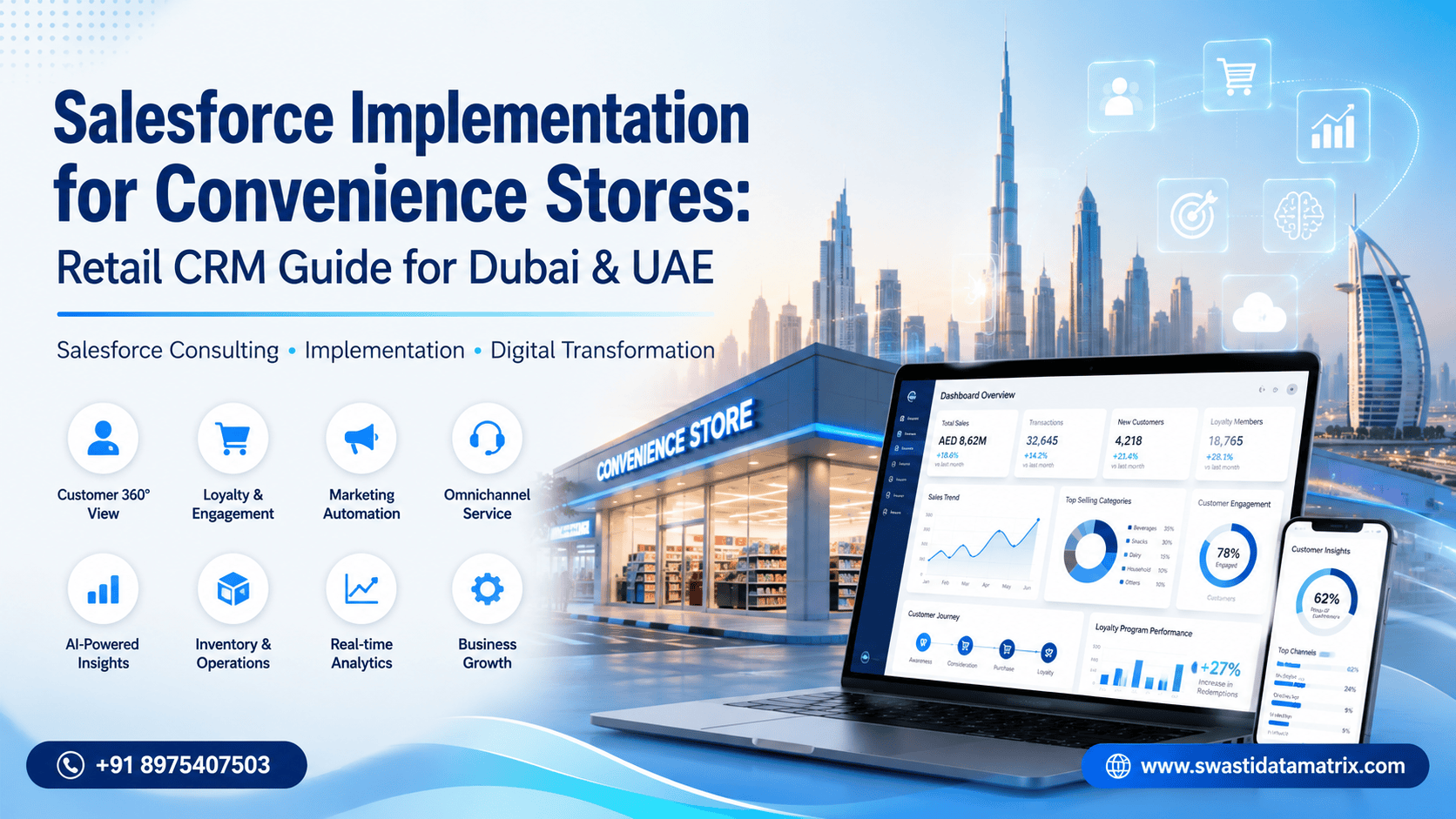
Salesforce Implementation for Convenience Stores: Retail CRM Guide for Dubai & UAE
The convenience store industry across Dubai, Abu Dhabi, and the wider UAE is evolving rapidly. Customers expect quick service, personalized offers, digital payment options, and seamless experiences across physical stores, mobile apps, and online ordering platforms. As competition grows, convenience store operators need more than a traditional point-of-sale (POS) system—they need a connected customer relationship management (CRM) platform.
Salesforce provides a powerful foundation for convenience stores looking to improve customer engagement, streamline operations, and make data-driven decisions. By integrating sales, service, marketing, loyalty programs, and analytics into a single platform, Salesforce helps retailers deliver personalized shopping experiences while improving operational efficiency.
Whether you operate a single neighborhood convenience store or manage a regional chain across the UAE or Saudi Arabia, Salesforce can support your digital transformation journey with scalable, AI-powered solutions.
Why Convenience Stores Need Salesforce
Modern convenience stores are no longer just places for quick purchases. They are becoming customer-centric retail hubs offering:
- Loyalty programs
- Click-and-collect services
- Mobile ordering
- Personalized promotions
- Digital wallets
- Omnichannel customer support
Managing these touchpoints manually or with disconnected systems often leads to inconsistent customer experiences and missed revenue opportunities.
Salesforce addresses these challenges by creating a unified view of every customer, enabling businesses to understand purchasing behavior, automate marketing campaigns, and improve customer service.
For businesses operating in Dubai and the UAE, where consumers expect fast, multilingual, and personalized interactions, Salesforce provides the agility needed to stay competitive.
Common Business Challenges
Convenience stores face several operational and customer-related challenges that can limit growth.
| Challenge | Business Impact |
|---|---|
| Disconnected customer data | Inconsistent customer experiences |
| Low customer retention | Reduced repeat purchases |
| Limited marketing automation | Ineffective promotional campaigns |
| Manual inventory communication | Delayed replenishment |
| Poor customer support | Lower satisfaction and loyalty |
| Lack of business insights | Slow decision-making |
| Multiple store management | Operational inefficiencies |
These issues become more pronounced as businesses expand across multiple locations in Dubai, Abu Dhabi, or Saudi Arabia.
How Salesforce Solves These Challenges
Salesforce connects customer interactions, store operations, and marketing activities within a unified CRM platform.
Unified Customer Profiles
Salesforce consolidates customer information from POS systems, websites, loyalty programs, and mobile apps into a single profile. This enables staff to provide personalized service and targeted recommendations.
Marketing Automation
Retailers can automate email campaigns, SMS promotions, loyalty rewards, and seasonal offers based on customer behavior and purchase history.
Omnichannel Customer Service
Customers can engage through email, phone, WhatsApp integrations, websites, or social media while service teams access the same customer information across channels.
AI-Powered Recommendations
With Salesforce's AI capabilities, businesses can identify purchasing trends, recommend products, and predict customer needs, improving engagement and sales.
Real-Time Analytics
Interactive dashboards provide insights into sales performance, customer behavior, campaign effectiveness, and operational KPIs, enabling faster and more informed decision-making.
Salesforce Products Relevant for Convenience Stores
Sales Cloud
Sales Cloud helps convenience store chains manage B2B relationships with suppliers, distributors, and corporate clients. It streamlines sales processes, tracks opportunities, and improves collaboration across teams.
Service Cloud
Service Cloud enables efficient handling of customer inquiries, complaints, and support requests across multiple channels, ensuring faster response times and higher customer satisfaction.
Marketing Cloud
Marketing Cloud empowers retailers to create personalized, automated marketing campaigns across email, SMS, and social media. Businesses can engage customers with relevant offers based on shopping behavior and loyalty status.
For organizations looking to maximize customer engagement, partnering with a provider offering Salesforce Marketing Cloud Services UAE can help design, implement, and optimize personalized marketing strategies.
Data Cloud
Data Cloud unifies customer data from multiple systems, providing a comprehensive view of each customer. This supports better segmentation, personalization, and AI-driven insights.
Agentforce
Agentforce introduces AI-powered digital agents capable of assisting customers with product inquiries, loyalty program information, and common support requests. This helps improve service availability while reducing manual workloads.
CRM Analytics
CRM Analytics delivers real-time dashboards and reports that help store managers monitor sales trends, inventory performance, customer engagement, and campaign ROI.
Benefits of Salesforce Implementation
Implementing Salesforce offers measurable business advantages for convenience stores.
| Benefit | Business Value |
|---|---|
| Personalized customer experiences | Higher customer satisfaction |
| Centralized customer data | Better decision-making |
| Automated marketing | Increased campaign efficiency |
| AI-powered insights | Improved forecasting |
| Omnichannel engagement | Consistent customer experience |
| Faster customer support | Improved loyalty |
| Scalable platform | Supports business growth |
| Real-time reporting | Enhanced operational visibility |
These benefits contribute to stronger customer relationships and more efficient retail operations.
Salesforce Implementation Process
A successful Salesforce implementation typically follows a structured approach:
1. Business Assessment
Evaluate existing systems, operational challenges, customer journeys, and business objectives.
2. Solution Design
Design a Salesforce architecture aligned with business requirements, including integrations with POS systems, ERP platforms, and eCommerce solutions.
3. Customization
Configure Salesforce to match business workflows, dashboards, user roles, and reporting needs.
Organizations seeking advanced functionality can benefit from Salesforce Development Services to build custom applications, automate workflows, and integrate third-party systems.
4. Data Migration
Migrate customer, sales, loyalty, and operational data securely into Salesforce while maintaining data quality.
5. Integration
Connect Salesforce with payment gateways, inventory systems, accounting software, and marketing platforms to create a unified ecosystem.
6. User Training
Train employees to use Salesforce effectively, ensuring high user adoption and maximizing return on investment.
7. Go-Live and Optimization
Deploy the solution, monitor performance, gather user feedback, and continuously optimize processes based on business needs.
Working with an experienced Salesforce Implementation Partner Dubai and leveraging Salesforce Consulting UAE services can help reduce implementation risks and accelerate time-to-value.
Salesforce Implementation Roadmap
| Phase | Key Activities |
|---|---|
| Discovery | Business analysis, stakeholder workshops |
| Planning | Solution architecture, implementation roadmap |
| Design | CRM configuration, workflow design |
| Development | Customization, integrations, automation |
| Testing | Functional testing, user acceptance testing |
| Deployment | Go-live, user onboarding |
| Optimization | Performance monitoring, enhancements |
Pricing / Cost of Salesforce Implementation for Convenience Stores
The cost of implementing Salesforce depends on several factors, including the number of users, selected Salesforce products, required integrations, customization, data migration, and ongoing support.
| Cost Factor | Description |
|---|---|
| Salesforce Licenses | Varies based on the selected Salesforce Cloud and edition |
| Implementation | Discovery, configuration, customization, testing, and deployment |
| Integrations | POS, ERP, accounting, inventory, payment gateways, and eCommerce |
| Data Migration | Importing customer, product, and transaction data |
| User Training | Administrator and end-user training |
| Managed Services | Ongoing enhancements, support, and optimization |
For small convenience store chains, implementations are generally less complex than enterprise retail projects. Multi-store retailers with omnichannel operations, loyalty programs, and custom integrations should plan for a broader implementation scope.
Partnering with an experienced Salesforce Implementation Partner Dubai helps businesses define a realistic budget while aligning the solution with long-term growth objectives.
Implementation Timeline
A typical Salesforce implementation follows this timeline:
| Business Size | Estimated Timeline |
|---|---|
| Single Store | 4–8 weeks |
| Small Multi-Store Chain | 8–12 weeks |
| Regional Retail Chain | 3–6 months |
| Enterprise Retail Group | 6+ months |
Actual timelines depend on business complexity, existing systems, data quality, customization requirements, and stakeholder availability.
Industry Use Cases
Customer Loyalty Programs
Reward customers based on purchase history with personalized offers, birthday discounts, cashback promotions, and exclusive rewards.
Multi-Store Operations
Provide regional managers with centralized dashboards to monitor sales performance, inventory trends, customer satisfaction, and marketing effectiveness across multiple locations.
Personalized Marketing
Automatically send targeted promotions based on shopping habits, seasonal demand, and customer preferences using Salesforce Marketing Cloud.
Customer Service
Handle product inquiries, refund requests, and loyalty-related questions across email, chat, phone, and social media through a unified service platform.
Executive Reporting
Deliver real-time visibility into KPIs such as average basket size, repeat purchase rate, customer lifetime value, and campaign ROI.
Convenience Store CRM Comparison
| Feature | Traditional POS System | Salesforce CRM |
|---|---|---|
| Customer Profiles | Basic | Comprehensive 360° View |
| Loyalty Management | Limited | Advanced Personalization |
| Marketing Automation | Minimal | Multi-Channel Automation |
| Customer Service | Separate Systems | Unified Platform |
| AI Insights | No | Yes |
| Analytics | Basic Reports | Interactive Dashboards |
| Scalability | Limited | Enterprise-Ready |
Latest Salesforce Trends for 2026
The retail CRM landscape continues to evolve, and convenience stores can benefit from several emerging Salesforce capabilities.
Agentforce for Retail
AI-powered digital agents are helping retailers automate customer support, assist with loyalty program queries, answer product questions, and guide customers through self-service experiences.
AI-Powered CRM
Artificial intelligence is increasingly used to recommend products, predict purchasing behavior, identify at-risk customers, and optimize marketing campaigns.
Data Cloud
Retailers are investing in unified customer data platforms to combine information from POS systems, mobile apps, websites, loyalty programs, and customer service interactions.
Hyper-Personalization
Customers increasingly expect personalized recommendations, promotions, and communications based on their preferences and shopping behavior.
Predictive Analytics
Retail managers are leveraging predictive insights to forecast demand, improve inventory planning, and identify sales opportunities.
First-Party Customer Data
With increasing privacy regulations, businesses are prioritizing first-party customer data collected through loyalty programs, mobile applications, and direct customer interactions.
Low-Code Development
Salesforce's low-code tools enable businesses to build workflows, approval processes, and applications faster without extensive coding.
Omnichannel Customer Engagement
Consumers expect seamless experiences whether they shop in-store, online, or through mobile apps. Salesforce helps maintain consistent engagement across every touchpoint.
Best Practices for Salesforce Implementation
- Clearly define business objectives before implementation.
- Standardize customer data before migration.
- Integrate Salesforce with existing retail systems.
- Automate repetitive workflows where possible.
- Train employees thoroughly to improve user adoption.
- Monitor KPIs continuously using CRM Analytics.
- Start with high-impact use cases before expanding functionality.
- Regularly review and optimize CRM processes as business needs evolve.
Common Mistakes to Avoid
- Implementing Salesforce without a clear strategy.
- Migrating poor-quality customer data.
- Ignoring employee training.
- Over-customizing the platform unnecessarily.
- Delaying system integrations.
- Focusing only on technology instead of business processes.
- Failing to measure implementation success through KPIs.
Salesforce Implementation Checklist
| Checklist |
|---|
| Define business objectives |
| Identify key stakeholders |
| Audit existing systems |
| Clean customer data |
| Select relevant Salesforce products |
| Plan integrations |
| Configure automation workflows |
| Train users |
| Perform testing |
| Monitor adoption and optimize continuously |
Case Study
Industry
Convenience Store Retail
Challenge
QuickMart Express operated 18 convenience stores across Dubai and Abu Dhabi. Customer information was fragmented across POS systems, loyalty software, spreadsheets, and separate marketing platforms. Marketing campaigns lacked personalization, and customer support requests were handled manually.
Solution
The company implemented Salesforce to centralize customer data, automate marketing campaigns, improve customer service, and provide real-time operational reporting.
Salesforce Products Used
- Sales Cloud
- Service Cloud
- Marketing Cloud
- Data Cloud
- CRM Analytics
Implementation
Over a 12-week period, Salesforce was integrated with the retailer's POS system, loyalty platform, and inventory management software. Automated customer journeys and executive dashboards were developed to support marketing and operational decision-making.
Results
Within the first several months after deployment, the business observed:
- 35% increase in customer engagement
- 29% improvement in loyalty campaign performance
- 45?ster response time for customer inquiries
- 28% reduction in manual administrative work
- Improved visibility into multi-store operations
These results are illustrative and may vary depending on implementation quality, business processes, and organizational adoption.
ROI
The retailer improved operational efficiency while strengthening customer relationships, enabling management to make faster, data-driven decisions.
Lessons Learned
Success depended not only on technology but also on strong change management, employee training, clean data, and continuous optimization.
Frequently Asked Questions (FAQs)
1. What is Salesforce implementation for convenience stores?
It is the process of configuring Salesforce to manage customer relationships, marketing, sales, service, and analytics for convenience store operations.
2. Why is Salesforce important for convenience stores?
It helps improve customer loyalty, automate operations, centralize data, and provide actionable business insights.
3. Which Salesforce products are most relevant?
Sales Cloud, Service Cloud, Marketing Cloud, Data Cloud, CRM Analytics, and Agentforce are commonly used.
4. How long does implementation take?
Typically between 4 weeks and 6 months, depending on project complexity.
5. How much does Salesforce implementation cost?
Costs vary based on licenses, customization, integrations, and implementation scope.
6. Can Salesforce integrate with POS systems?
Yes. Salesforce can integrate with many modern POS, ERP, inventory, and payment systems.
7. Is Salesforce suitable for small convenience store chains?
Yes. Salesforce scales from single-store businesses to large regional retail groups.
8. What are the main implementation challenges?
Data quality, system integration, user adoption, and process alignment are common challenges.
9. Why should businesses work with a Salesforce implementation partner?
An experienced partner helps reduce project risks, accelerates deployment, and ensures the solution aligns with business objectives.
10. Can Salesforce improve customer loyalty?
Yes. Personalized marketing, automated rewards, and unified customer profiles help strengthen long-term customer relationships.
11. How does AI benefit convenience stores?
AI helps predict customer behavior, recommend products, automate customer support, and improve marketing effectiveness.
12. Is Salesforce secure for retail businesses?
Salesforce provides enterprise-grade security features, role-based access controls, encryption capabilities, and compliance tools to help organizations protect customer data.
Conclusion
As customer expectations continue to evolve across Dubai, the UAE, and Saudi Arabia, convenience stores need more than standalone retail software to remain competitive. A connected CRM platform like Salesforce enables businesses to unify customer data, automate marketing, improve customer service, and gain real-time operational insights.
Whether your goal is to strengthen customer loyalty, optimize multi-store operations, or accelerate digital transformation, Salesforce provides the flexibility and scalability to support long-term growth. Working with an experienced implementation partner ensures the platform is tailored to your business processes and delivers measurable business value.
Why Choose Swasti Data Matrix?
Swasti Data Matrix helps businesses across the UAE and Saudi Arabia unlock the full potential of Salesforce through consulting, implementation, customization, integration, migration, and managed services.
Our expertise includes:
- Salesforce Consulting
- Salesforce Implementation
- Salesforce Development
- Salesforce Integration
- Data Migration
- Marketing Cloud Implementation
- CRM Customization
- Managed Salesforce Services
We work closely with organizations to design scalable CRM solutions that align with their business goals while supporting digital transformation initiatives.
Explore our Salesforce services:
- Salesforce Development Services
- Salesforce Marketing Cloud Services UAE
- Salesforce Implementation Partner Dubai
- Salesforce Consulting UAE
- Salesforce Consulting Saudi Arabia
Website: https://www.swastidatamatrix.com
Phone: +91 8975407503
Book a free consultation to discuss your Salesforce implementation strategy and discover how a modern CRM can help your convenience store business improve customer engagement, streamline operations, and achieve sustainable growth.
