

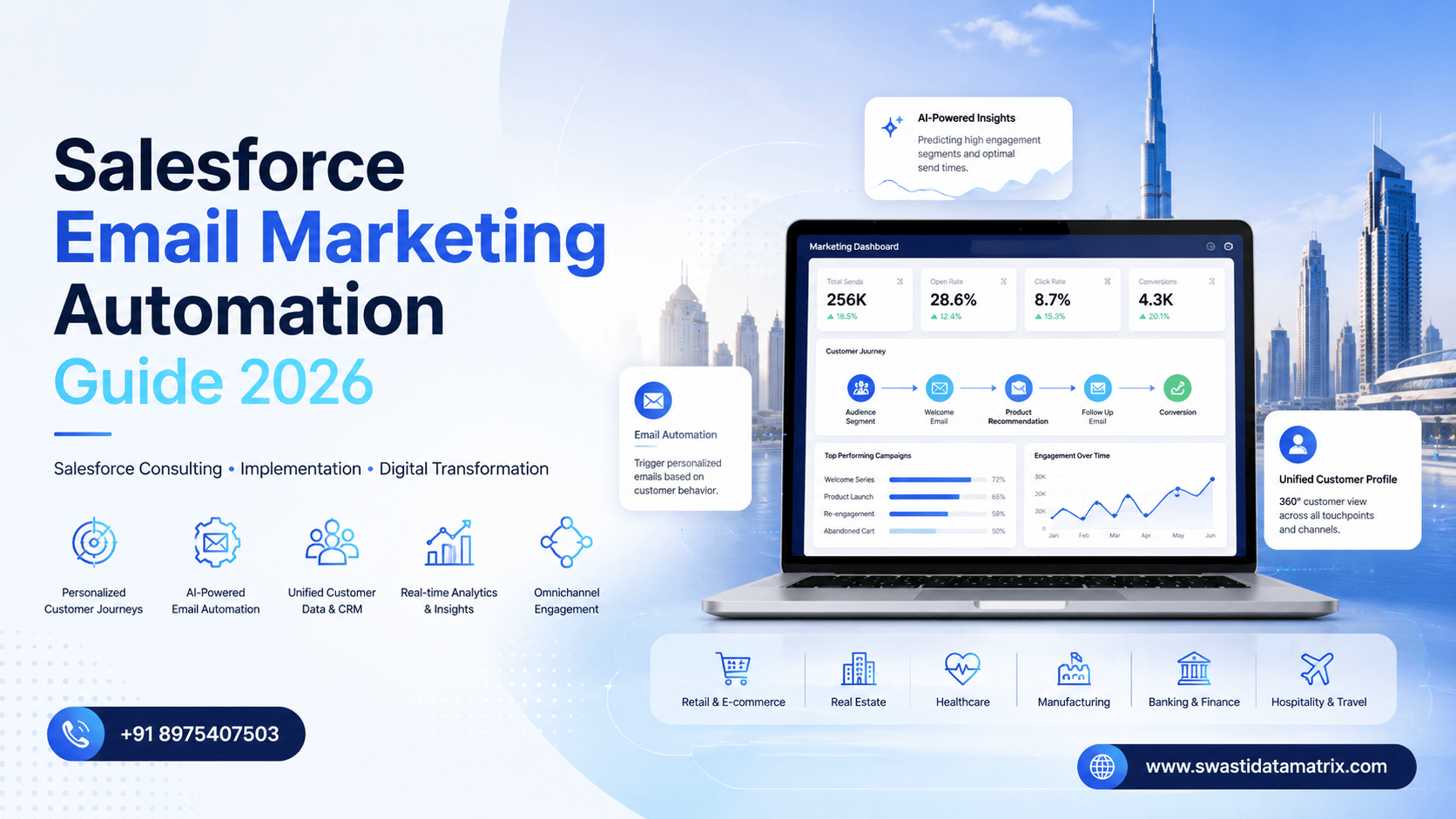
Salesforce Email Marketing Automation Guide 2026
Introduction
Email remains one of the highest-performing digital marketing channels, but today's customers expect much more than promotional newsletters. They expect personalized recommendations, timely follow-ups, and consistent experiences across every interaction. Businesses that continue sending generic, one-size-fits-all emails often struggle with low engagement, declining conversions, and increasing unsubscribe rates.
Salesforce Email Marketing Automation enables organizations to deliver highly personalized, data-driven email campaigns at scale. By combining customer relationship management (CRM), artificial intelligence (AI), and automation, businesses can send the right message to the right customer at exactly the right time.
For organizations across Dubai, UAE, Abu Dhabi, Saudi Arabia, and the wider Middle East, email automation has become a key component of digital transformation. Whether you're nurturing B2B leads, recovering abandoned shopping carts, onboarding new customers, or running loyalty campaigns, Salesforce provides the tools to create connected customer journeys while reducing manual effort.
Unlike traditional email marketing platforms that operate independently, Salesforce integrates customer data, sales activities, service interactions, website behavior, and AI-driven insights into a single ecosystem. This allows marketing teams to make better decisions, improve campaign performance, and create meaningful customer experiences.
In this guide, you'll learn:
- What Salesforce Email Marketing Automation is
- Why it matters in 2026
- How it works
- Which Salesforce products support email automation
- Benefits for different industries
- Implementation considerations
- Emerging trends shaping the future of marketing automation
Whether you're evaluating Salesforce Marketing Cloud for the first time or planning to modernize your existing marketing strategy, this guide will help you understand how to maximize your investment.
What is Salesforce Email Marketing Automation?
Salesforce Email Marketing Automation is the process of using Salesforce technologies—primarily Marketing Cloud—to automatically send personalized, behavior-based email communications throughout the customer lifecycle.
Instead of manually creating and sending individual campaigns, businesses can design automated workflows that respond to customer actions and business events.
Examples include:
- Welcome email sequences
- Lead nurturing campaigns
- Product recommendations
- Event invitations
- Birthday and anniversary emails
- Renewal reminders
- Abandoned cart recovery
- Customer onboarding
- Re-engagement campaigns
- Post-purchase follow-ups
These journeys are powered by customer data, business rules, AI recommendations, and real-time engagement signals, ensuring each recipient receives content that is relevant to their needs and stage in the buying journey.
Why Businesses Need Salesforce Email Marketing Automation
Modern customers interact with businesses through websites, mobile apps, social media, messaging platforms, physical stores, and customer service channels. Managing these interactions manually is no longer practical, especially for organizations serving thousands or millions of customers.
Salesforce Email Marketing Automation helps organizations create consistent, personalized communication without increasing operational complexity.
Businesses in the UAE and Saudi Arabia also face unique challenges, including multilingual audiences, diverse customer segments, and evolving data privacy regulations. Automation enables marketers to tailor campaigns based on language preferences, geographic location, customer behavior, and purchase history while maintaining compliance and consistency.
Key Business Benefits
- Deliver personalized communication at scale
- Improve lead nurturing and customer retention
- Increase marketing efficiency
- Reduce repetitive manual tasks
- Enhance customer engagement
- Align marketing and sales teams
- Support omnichannel customer experiences
- Improve reporting and campaign visibility
- Enable data-driven marketing decisions
- Scale marketing operations as the business grows
For organizations pursuing digital transformation, email automation is no longer a "nice-to-have" capability—it is a foundational component of a modern customer engagement strategy.
Common Business Challenges
Despite significant investments in marketing technology, many organizations still struggle to achieve consistent email marketing results.
Some of the most common challenges include:
| Challenge | Business Impact |
|---|---|
| Generic email campaigns | Low engagement and conversions |
| Disconnected customer data | Inconsistent messaging |
| Manual campaign execution | Increased operational costs |
| Poor lead nurturing | Lost sales opportunities |
| Limited personalization | Reduced customer satisfaction |
| Lack of performance insights | Difficulty optimizing campaigns |
| Inconsistent follow-ups | Lower customer retention |
| Multiple disconnected marketing tools | Operational inefficiencies |
| Difficulty scaling campaigns | Slower business growth |
These issues often become more pronounced as businesses expand into new regions, launch additional products, or serve increasingly diverse customer bases.
How Salesforce Solves These Challenges
Salesforce brings together CRM, marketing automation, AI, analytics, and customer data into a unified platform, enabling organizations to deliver more relevant and timely communications.
Unified Customer Data
Salesforce consolidates customer information from multiple touchpoints into a single customer view. Marketers gain access to purchase history, website interactions, support cases, preferences, and engagement metrics, making it easier to create highly targeted campaigns.
AI-Powered Personalization
With Salesforce AI capabilities, businesses can recommend products, optimize send times, personalize subject lines, and predict customer engagement. These insights help marketers improve campaign effectiveness without relying solely on manual analysis.
Customer Journey Automation
Rather than sending isolated campaigns, Salesforce enables businesses to design end-to-end customer journeys. Automated workflows can guide prospects from initial awareness through purchase, onboarding, and long-term loyalty.
Seamless Sales and Marketing Alignment
By integrating marketing automation with CRM, sales teams gain visibility into marketing engagement. They can identify highly interested prospects, prioritize follow-ups, and provide more informed conversations.
Advanced Analytics
Real-time dashboards and reporting allow marketers to monitor campaign performance, identify trends, and optimize future campaigns based on measurable outcomes.
Salesforce Products Relevant to Email Marketing Automation
Salesforce offers several products that work together to support sophisticated email marketing strategies.
Marketing Cloud
Marketing Cloud is the primary solution for email marketing automation. It enables businesses to build personalized customer journeys, automate campaigns, segment audiences, and analyze campaign performance from a centralized platform.
Organizations looking to implement or optimize Marketing Cloud can benefit from specialized Salesforce Marketing Cloud Services UAE, ensuring the platform is configured to align with business goals and regional requirements.
Sales Cloud
Sales Cloud provides the CRM foundation by managing leads, opportunities, contacts, and accounts. When integrated with Marketing Cloud, it enables seamless lead nurturing, sales handoffs, and closed-loop reporting.
Data Cloud
Data Cloud unifies customer information from multiple systems into a single, real-time profile. This enriched data supports more accurate segmentation, advanced personalization, and AI-driven marketing decisions.
Agentforce
Agentforce extends marketing capabilities by introducing AI-powered automation that assists with customer interactions, campaign optimization, and intelligent recommendations. Marketing teams can leverage AI agents to accelerate campaign execution, improve responsiveness, and deliver more personalized experiences.
CRM Analytics
CRM Analytics transforms marketing data into actionable insights. Teams can monitor campaign performance, customer engagement, conversion trends, and ROI through interactive dashboards, enabling continuous optimization.
Key Benefits of Salesforce Email Marketing Automation
| Benefit | Business Value |
|---|---|
| Personalized customer journeys | Higher engagement and loyalty |
| Automated workflows | Reduced manual effort |
| AI-powered recommendations | Better campaign performance |
| Unified customer data | More accurate targeting |
| Real-time analytics | Smarter decision-making |
| CRM integration | Better sales and marketing alignment |
| Scalable architecture | Supports business growth |
| Omnichannel engagement | Consistent customer experience |
| Advanced segmentation | More relevant communications |
| Compliance support | Better governance and data management |
Latest Salesforce Trends for 2026
Email marketing continues to evolve as customer expectations rise and AI capabilities mature. The following trends are shaping how organizations approach Salesforce-powered marketing automation in 2026.
Agentforce-Powered Marketing Assistance
AI agents are increasingly helping marketing teams automate repetitive tasks, generate campaign ideas, recommend audience segments, and optimize customer journeys. This allows marketers to focus more on strategy and creative execution while improving operational efficiency.
Hyper-Personalization at Scale
Customers now expect communications tailored to their preferences, behavior, and lifecycle stage. Salesforce enables businesses to move beyond basic personalization by leveraging real-time data and AI to deliver highly relevant content across every interaction.
First-Party Customer Data Strategies
With evolving privacy regulations and the decline of third-party cookies, organizations are placing greater emphasis on collecting and activating first-party customer data. Salesforce Data Cloud helps unify consented customer information from multiple sources, supporting compliant and effective marketing initiatives.
AI-Driven Predictive Analytics
Predictive analytics helps marketers anticipate customer needs, identify high-value prospects, forecast engagement, and optimize campaign timing. These insights enable more informed decisions and improved marketing outcomes.
Omnichannel Customer Engagement
Email is increasingly integrated with SMS, mobile notifications, social media, live chat, and customer service interactions. Salesforce supports connected journeys across channels, ensuring customers receive consistent and contextual experiences.
Low-Code Marketing Automation
Low-code tools empower marketing teams to build and modify automation workflows with minimal technical effort. This accelerates campaign deployment and allows businesses to respond more quickly to changing market demands.
Salesforce Email Marketing Automation Implementation Process
A successful Salesforce Email Marketing Automation implementation goes beyond purchasing licenses. It requires aligning marketing goals, customer data, business processes, and technology to create meaningful customer experiences.
For businesses in Dubai, UAE, Abu Dhabi, and Saudi Arabia, it is also important to consider multilingual communication, regulatory compliance, integration with existing ERP or CRM systems, and scalability for future growth.
Phase 1: Business Discovery & Strategy
The implementation begins with understanding your organization's objectives.
Typical discovery activities include:
- Identifying marketing goals
- Defining customer personas
- Mapping customer journeys
- Reviewing existing CRM data
- Auditing current email campaigns
- Evaluating integration requirements
- Establishing KPIs
Typical KPIs include:
- Email open rate
- Click-through rate (CTR)
- Lead conversion rate
- Customer acquisition cost
- Customer lifetime value
- Revenue attributed to email campaigns
- Marketing ROI
A well-defined strategy ensures technology supports business objectives rather than driving them.
Phase 2: Data Assessment & Preparation
High-quality data is the foundation of effective marketing automation.
Key activities include:
- Removing duplicate contacts
- Standardizing customer records
- Validating email addresses
- Managing consent preferences
- Organizing customer segments
- Creating unified customer profiles
For organizations operating across the Middle East, maintaining multilingual customer data—including English and Arabic preferences—can significantly improve campaign relevance and engagement.
Phase 3: Salesforce Marketing Cloud Configuration
Once the data is prepared, Marketing Cloud is configured to support your business requirements.
Configuration typically includes:
- Business Units
- Email Studio
- Journey Builder
- Automation Studio
- Contact Builder
- Content Builder
- Mobile Studio (if required)
- Preference Centers
- Sender Authentication
- Domain Configuration
Security, user permissions, and governance policies should also be established at this stage.
Phase 4: CRM & System Integration
Marketing automation delivers the greatest value when connected with your existing business systems.
Common integrations include:
- Salesforce Sales Cloud
- Salesforce Service Cloud
- ERP platforms
- E-commerce platforms
- Payment gateways
- Customer support systems
- CMS platforms
- Data warehouses
- Third-party marketing tools
Organizations seeking seamless integration often work with an experienced Salesforce Development Services provider to develop secure APIs, automate workflows, and ensure reliable data synchronization across systems.
Phase 5: Customer Journey Design
This is where automation begins creating real business value.
Marketing teams design customer journeys based on behaviors such as:
- Website visits
- Form submissions
- Product purchases
- Cart abandonment
- Event registrations
- Customer support interactions
- Subscription renewals
- Loyalty milestones
Example automated journey:
Visitor downloads an eBook --> Welcome email --> Educational content --> Industry case study --> Product demonstration invitation --> Sales consultation --> Customer onboarding --> Feedback campaign --> Loyalty program --> Each interaction occurs automatically based on predefined rules and customer behavior.
Phase 6: Testing & Quality Assurance
Before campaigns go live, organizations should validate:
- Personalization accuracy
- Dynamic content rendering
- Email responsiveness
- Deliverability
- Spam score
- Broken links
- Trigger timing
- Workflow logic
- Multilingual content
- Mobile compatibility
Thorough testing helps protect brand reputation and ensures a consistent customer experience.
Phase 7: Go-Live & Continuous Optimization
Implementation does not end after launch.
Successful organizations continuously monitor:
- Open rates
- Click rates
- Bounce rates
- Conversion rates
- Unsubscribe rates
- Journey completion
- Customer engagement
- Revenue contribution
Campaigns should be refined using A/B testing, AI recommendations, and customer feedback to improve performance over time.
Industry Use Cases
Salesforce Email Marketing Automation can be adapted across industries, each with its own customer lifecycle, compliance requirements, and communication goals.
Retail & E-Commerce
Retailers use automation to:
- Recover abandoned carts
- Recommend products
- Promote seasonal offers
- Send loyalty rewards
- Encourage repeat purchases
Business Outcome:
Higher customer retention and increased average order value.
Real Estate
Property developers and brokers automate:
- Property recommendations
- Buyer nurturing
- Appointment scheduling
- Investment updates
- Project launch announcements
This enables sales teams to focus on qualified buyers rather than manual follow-ups.
Healthcare
Healthcare organizations use Salesforce for:
- Appointment reminders
- Wellness campaigns
- Patient education
- Preventive care notifications
- Service follow-ups
Compliance with local healthcare regulations remains essential when managing patient communications.
Banking & Financial Services
Financial institutions automate:
- Loan application updates
- Credit card offers
- Investment newsletters
- KYC reminders
- Customer onboarding
Personalized financial communications help improve trust while supporting regulatory requirements.
Manufacturing
Manufacturers automate communication with:
- Dealers
- Distributors
- Suppliers
- Existing customers
Examples include:
- Product launch announcements
- Maintenance reminders
- Warranty notifications
- Dealer enablement campaigns
Education
Educational institutions use automation for:
- Student admissions
- Event invitations
- Alumni engagement
- Course recommendations
- Enrollment reminders
Hospitality & Travel
Hotels and travel companies automate:
- Booking confirmations
- Travel updates
- Loyalty promotions
- Guest feedback surveys
- Personalized vacation recommendations
Salesforce Products Comparison
| Salesforce Product | Role in Email Marketing Automation | Best For |
|---|---|---|
| Marketing Cloud | Customer journeys, email campaigns, personalization | Enterprise marketing |
| Sales Cloud | Lead management and CRM | Sales teams |
| Data Cloud | Unified customer profiles | Customer intelligence |
| Agentforce | AI-assisted automation and recommendations | Productivity and personalization |
| CRM Analytics | Reporting and campaign insights | Marketing leadership |
| Experience Cloud | Customer portals and digital engagement | Partner and customer communities |
Salesforce vs Traditional Email Marketing Platforms
| Feature | Salesforce Marketing Cloud | Traditional Email Platform |
|---|---|---|
| CRM Integration | Native | Limited |
| AI Personalization | Advanced | Basic |
| Journey Automation | Advanced | Moderate |
| Customer Data | Unified | Fragmented |
| Omnichannel Marketing | Yes | Usually Email Only |
| Predictive Analytics | Yes | Limited |
| Enterprise Scalability | Excellent | Moderate |
| API Integrations | Extensive | Varies |
| Security & Governance | Enterprise Grade | Platform Dependent |
Benefits at a Glance
| Business Goal | Salesforce Benefit |
|---|---|
| Increase engagement | Personalized journeys |
| Improve ROI | AI-driven optimization |
| Reduce manual work | Workflow automation |
| Better lead nurturing | CRM integration |
| Increase retention | Lifecycle campaigns |
| Improve reporting | Real-time dashboards |
| Scale operations | Cloud infrastructure |
| Better customer experience | Omnichannel engagement |
Salesforce Email Marketing Automation Pricing
Pricing depends on several factors, including:
-
Salesforce edition
- Number of contacts
- Monthly email volume
- AI capabilities
- Data Cloud usage
- Integration complexity
- Custom development
- Training requirements
- Managed services
Implementation costs also vary depending on business size, existing infrastructure, and customization needs.
Typical Cost Factors
| Component | Cost Driver |
|---|---|
| Salesforce licenses | Edition and user count |
| Marketing Cloud | Contacts and features |
| Data migration | Data quality and volume |
| Integrations | Number of connected systems |
| Customization | Workflow complexity |
| Training | Number of users |
| Ongoing support | Managed service requirements |
For an accurate estimate, organizations should conduct a discovery workshop with an experienced Salesforce Implementation Partner Dubai or a certified Salesforce consulting team.
Typical Implementation Timeline
| Project Size | Estimated Timeline |
|---|---|
| Small Business | 4–8 weeks |
| Mid-Sized Organization | 8–14 weeks |
| Enterprise Implementation | 3–6 months |
| Multi-country Deployment | 6–12 months |
The timeline depends on factors such as:
- Data quality
- Existing CRM maturity
- Number of integrations
- Custom development
- Compliance requirements
- User training
- Change management
Best Practices
Organizations consistently achieve better outcomes when they:
-
Start with clearly defined business objectives.
- Build customer journeys around real user behavior rather than assumptions.
- Keep customer data clean and regularly updated.
- Use audience segmentation instead of sending generic campaigns.
- Personalize subject lines, content, and calls to action.
- Test campaigns before every launch.
- Monitor campaign analytics and optimize continuously.
- Combine email with SMS, mobile notifications, and other channels where appropriate.
- Respect customer consent and regional privacy regulations.
- Train marketing and sales teams to use Salesforce effectively.
Common Mistakes to Avoid
Many email automation projects underperform because of avoidable issues.
Common mistakes include:
- Treating automation as "set it and forget it."
- Using poor-quality or outdated customer data.
- Sending the same message to every customer.
- Ignoring customer preferences and language settings.
- Overcomplicating automation journeys.
- Failing to integrate marketing with CRM data.
- Measuring vanity metrics instead of business outcomes.
- Neglecting deliverability and sender reputation.
- Launching campaigns without testing.
- Underestimating change management and user adoption.
Salesforce Email Marketing Automation Checklist
| Checklist Item | Status |
|---|---|
| Marketing objectives defined | |
| Customer personas created | |
| CRM data cleaned | |
| Consent preferences reviewed | |
| Audience segmentation completed | |
| Marketing Cloud configured | |
| CRM integration completed | |
| Customer journeys designed | |
| Testing completed | |
| Analytics dashboards configured | |
| Team training completed | |
| Optimization plan established |
Realistic Business Case Study
Industry
Furniture & Home Retail
Challenge
The company operated physical stores across Dubai and Abu Dhabi alongside an online store. Marketing campaigns were sent manually, resulting in inconsistent communication, low personalization, and limited visibility into campaign performance. Sales and marketing teams also lacked a unified view of customer interactions.
Solution
The organization implemented Salesforce Marketing Cloud integrated with Sales Cloud and Data Cloud. Automated customer journeys were created for welcome emails, abandoned carts, post-purchase follow-ups, loyalty campaigns, and seasonal promotions. AI-driven audience segmentation improved targeting based on customer behavior and purchase history.
Salesforce Products Used
-
Marketing Cloud
- Sales Cloud
- Data Cloud
- CRM Analytics
- Agentforce
Implementation
The project included data cleansing, CRM integration, customer journey design, multilingual email templates (English and Arabic), staff training, and phased deployment over approximately three months.
Results (Illustrative Only)
After implementation, the organization observed:
- Approximately 32% increase in lead conversion
- Around 27% improvement in customer engagement
- Nearly 25% reduction in manual marketing activities
- Faster campaign execution and better visibility into marketing performance
- Improved collaboration between sales and marketing teams
These figures are illustrative examples. Actual results vary depending on implementation quality, business processes, industry, and customer engagement strategies.
ROI
The company reported stronger marketing efficiency, better customer retention, and improved campaign attribution, helping justify continued investment in Salesforce automation.
Lessons Learned
-
Clean data is essential for effective personalization.
- Cross-functional collaboration improves implementation success.
- Continuous optimization delivers better long-term ROI than one-time campaign launches.
- AI insights are most valuable when supported by accurate customer data.
Frequently Asked Questions (FAQs)
1. What is Salesforce Email Marketing Automation?
Salesforce Email Marketing Automation is the use of Salesforce technologies—primarily Marketing Cloud—to automate personalized email campaigns based on customer behavior, preferences, and lifecycle stages. It helps businesses improve engagement, increase efficiency, and deliver more relevant customer experiences.
2. Why is Salesforce Email Marketing Automation important?
It enables organizations to send targeted, timely, and personalized communications at scale while reducing manual effort. It also improves campaign performance, customer retention, and marketing ROI through automation and AI-driven insights.
3. How does Salesforce Email Marketing Automation work?
The platform combines CRM data, customer behavior, AI, and automation rules to trigger emails automatically. Examples include welcome emails, abandoned cart reminders, lead nurturing sequences, renewal notifications, and post-purchase follow-ups.
4. Which Salesforce product is best for email marketing?
Salesforce Marketing Cloud is the primary solution for enterprise email marketing automation. It offers advanced customer journey orchestration, audience segmentation, personalization, AI capabilities, analytics, and omnichannel engagement.
5. Who should use Salesforce Email Marketing Automation?
It is suitable for organizations of all sizes, particularly those with growing customer databases and complex engagement needs, including:
- Retail & E-commerce
- Real Estate
- Healthcare
- Banking & Financial Services
- Manufacturing
- Hospitality
- Education
- B2B SaaS
- Professional Services
6. What are the benefits of Salesforce Email Marketing Automation?
Key benefits include:
- Personalized customer journeys
- Improved lead nurturing
- Higher customer engagement
- Reduced manual work
- AI-driven campaign optimization
- Better reporting and analytics
- Increased marketing efficiency
- Seamless CRM integration
- Omnichannel customer experiences
- Scalable marketing operations
7. How much does Salesforce Email Marketing Automation cost?
Pricing depends on factors such as:
- Salesforce edition
- Number of contacts
- Email volume
- Marketing Cloud features
- Data Cloud requirements
- Integrations
- Custom development
- Training
- Managed services
Because every organization has unique requirements, it's best to request a tailored assessment from a certified Salesforce consulting partner.
8. How long does implementation take?
Typical implementation timelines are:
| Business Size | Estimated Timeline |
|---|---|
| Small Business | 4–8 weeks |
| Mid-Sized Business | 8–14 weeks |
| Enterprise | 3–6 months |
| Multi-country Deployment | 6–12 months |
The actual duration depends on data quality, integration complexity, customization, and organizational readiness.
9. Can Salesforce integrate with my existing CRM or ERP?
Yes. Salesforce supports integration with a wide range of business systems, including ERP platforms, e-commerce solutions, customer support applications, payment gateways, websites, and third-party marketing tools. This creates a unified customer view and streamlines business processes.
10. Is Salesforce Email Marketing Automation suitable for businesses in the UAE and Saudi Arabia?
Yes. Salesforce is widely used by organizations across Dubai, Abu Dhabi, Saudi Arabia, and the broader Middle East. Its capabilities support multilingual communication, regional compliance requirements, and omnichannel customer engagement, making it well-suited for businesses operating in these markets.
11. What common mistakes should businesses avoid?
Avoid:
- Poor data quality
- Generic email campaigns
- Lack of audience segmentation
- Ignoring customer consent
- Overcomplicated automation workflows
- Failing to test campaigns
- Not measuring meaningful business KPIs
- Limited collaboration between marketing and sales teams
12. How does AI improve Salesforce email marketing?
AI enhances marketing by:
- Recommending personalized content
- Predicting customer engagement
- Optimizing email send times
- Improving audience segmentation
- Identifying high-value leads
- Supporting campaign optimization through intelligent recommendations
13. Why choose a Salesforce implementation partner?
An experienced Salesforce partner can help with strategy, implementation, data migration, system integration, customization, user training, and ongoing optimization. This reduces implementation risks, accelerates deployment, and helps organizations maximize the value of their Salesforce investment.
14. What KPIs should businesses monitor?
Important metrics include:
- Email open rate
- Click-through rate (CTR)
- Conversion rate
- Bounce rate
- Unsubscribe rate
- Customer engagement
- Revenue influenced by campaigns
- Marketing ROI
- Customer lifetime value (CLV)
15. Can Salesforce support omnichannel marketing?
Yes. Salesforce enables businesses to coordinate customer interactions across email, SMS, mobile notifications, social media, websites, customer service channels, and other digital touchpoints. This helps deliver a consistent and connected customer experience.
Conclusion
Email marketing has evolved from sending periodic newsletters to delivering intelligent, personalized customer experiences powered by data and automation. As organizations compete in increasingly digital markets, the ability to communicate with customers at the right moment, through the right channel, has become a significant competitive advantage.
Salesforce Email Marketing Automation empowers businesses to unify customer data, automate engagement, leverage AI-driven insights, and measure marketing performance with greater accuracy. Rather than replacing marketers, automation enables teams to focus on strategy, creativity, and customer relationships while routine tasks are handled efficiently.
For organizations across Dubai, UAE, Abu Dhabi, Saudi Arabia, and the wider Middle East, Salesforce provides a scalable foundation for modern marketing. Whether your goal is to generate more qualified leads, improve customer retention, increase campaign ROI, or support enterprise-wide digital transformation, Salesforce Marketing Cloud and its connected ecosystem can help you achieve those objectives through a structured and data-driven approach.
Successful implementations, however, depend on more than technology. They require thoughtful planning, high-quality customer data, well-designed customer journeys, effective integrations, user adoption, and continuous optimization. Working with an experienced Salesforce consulting partner can significantly improve implementation outcomes while ensuring the platform aligns with your long-term business strategy.
Ready to Transform Your Email Marketing with Salesforce?
At Swasti Data Matrix, we help businesses across Dubai, UAE, Abu Dhabi, Saudi Arabia, and the Middle East implement scalable Salesforce solutions that drive measurable business outcomes.
Our certified Salesforce consultants provide end-to-end services, including:
- Salesforce Consulting
- Salesforce Implementation
- Marketing Cloud Implementation
- CRM Migration
- Salesforce Integration
- Salesforce Customization
- Salesforce Development
- Marketing Automation Strategy
- Managed Salesforce Services
- Ongoing Optimization & Support
Whether you're starting a new Salesforce project or enhancing an existing implementation, our team can help you design a solution tailored to your business goals, customer journeys, and growth plans.
Why Choose Swasti Data Matrix?
- Experienced Salesforce consulting professionals
- Industry-focused implementation expertise
- Customer-centric solution design
- Strong integration and customization capabilities
- Scalable solutions for growing businesses
- Ongoing support and managed services
- Focus on measurable ROI and long-term success
Schedule a Free Salesforce Consultation
Website: https://www.swastidatamatrix.com
Salesforce Services
- Salesforce Development Services
- Salesforce Marketing Cloud Services UAE
- Salesforce Implementation Partner Dubai
- Salesforce Consulting UAE
- Salesforce Consulting Saudi Arabia
Phone: +91 8975407503
